Your barber mentioned a hair spa while you’re growing your hair out, and now you’re wondering whether it’s an actual treatment or just a fancy head massage with a hefty price tag. Fair question. Hair spas are one of the most recommended, and most misunderstood, services at Indian salons, so let’s walk through exactly what happens, what it does, and whether someone in your situation should bother.
What Is a Hair Spa, Really?
A hair spa is a multi-step, in-salon conditioning treatment designed to deeply nourish the hair shaft, soothe the scalp, and improve the overall texture and manageability of your hair. It is not a chemical service. Nothing permanent happens to your hair structure. Think of it less like a colour or keratin treatment and more like a very thorough, professional-grade deep conditioning session, with a scalp massage built in.
The results last anywhere from two to four weeks depending on your hair type, water quality, and how you maintain your hair at home. If you live in a city with hard water, like Delhi, Bangalore, or Mumbai’s suburbs, you may notice the softness fading a little faster.
The Step-by-Step Process
Salons vary in their exact protocol, and premium salons using professional ranges like Kérastase, Wella System Professional, or Matrix often have more structured rituals. But the core steps are fairly consistent.
Step 1: Hair and Scalp Analysis
A good stylist will assess your scalp condition (oily, dry, sensitive, balanced) and your hair type before selecting a product. This matters. A mask formulated for dry, colour-treated hair will not give you the same result if your hair is fine and scalp-oily. Do not skip this conversation, even if it feels brief.
Step 2: Pre-Wash Oil Application (Sometimes)
Some salons apply a warm oil or pre-treatment serum before shampooing. This softens the hair cuticle slightly and helps the treatment that follows absorb better. Not every salon includes this step, and that is fine. It is a nice-to-have, not essential.
Step 3: Clarifying or Treatment Shampoo
Your hair is washed with a shampoo suited to your scalp type. This is not your regular home shampoo. Professional formulas tend to cleanse more thoroughly without stripping, which sets the base for the mask to work properly. If your scalp has any active issues, a medicated or scalp-specific shampoo may be used at this stage.
Step 4: The Hair Spa Mask or Treatment Cream
This is the heart of the service. A rich conditioning mask, often protein-based, moisturising, or a blend of both, is applied section by section through your hair lengths and ends. Salons using Kérastase might reach for something from their Nutritive or Resistance range for dry or damaged hair. Wella System Professional has a range of masks categorised by hair condition. Matrix is often found in mid-range salons and works well for Indian hair that is chemically untreated but exposed to daily heat and pollution.
The mask is left on for anywhere from 15 to 30 minutes. Some salons use a steamer cap during this time to open the hair cuticle gently so the product can penetrate rather than just sit on the surface. If they offer steaming, take it. It makes a noticeable difference in how soft the results feel.
Step 5: Scalp Massage
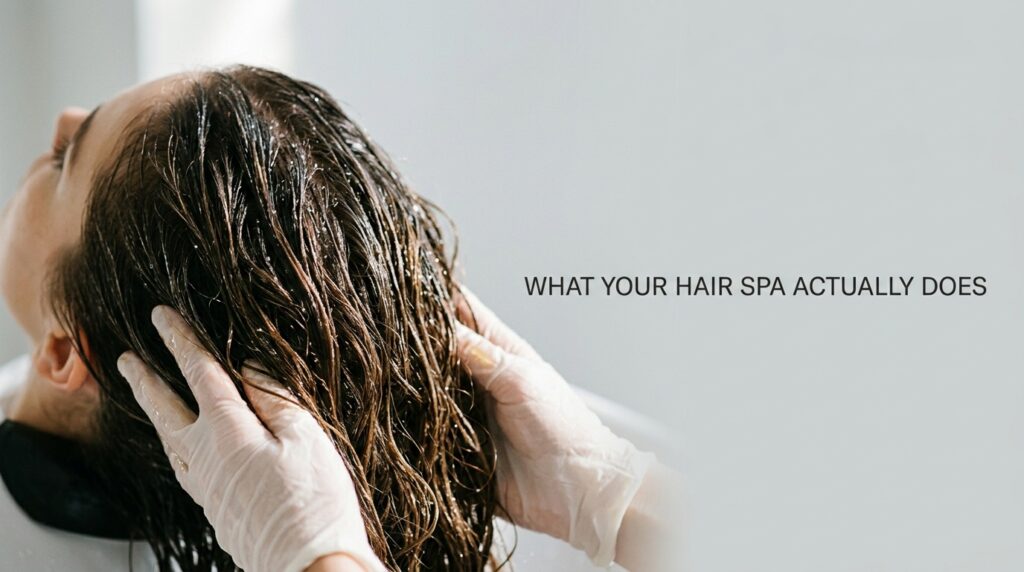
Usually done during or just before the mask sits, the scalp massage is genuinely one of the best parts of the experience. A proper massage stimulates blood flow to the scalp, relieves tension (especially if you are desk-bound), and simply feels relaxing. It does not, to be clear, regrow hair or cure hair fall. But for general scalp health and stress relief, it is worth a lot.
Step 6: Rinse and Toning (Optional)
The mask is rinsed thoroughly. Some salons follow with a light serum or leave-in conditioner to seal the cuticle. A cool water rinse at the end helps too, though not every salon bothers with this detail.
Step 7: Blow-Dry or Air-Dry and Finish
Your hair is dried and styled. You will usually notice the difference immediately: more shine, easier to comb through, and softer to touch.
What a Hair Spa Does (and Does Not Do)
It will genuinely improve the texture and manageability of your hair. It adds moisture and some structural support to the hair shaft, which reduces frizz and makes the hair look healthier. In Indian humidity and heat, that matters.
It will not repair split ends permanently. Once a split end is split, the only fix is a trim. It will not treat dandruff, seborrheic dermatitis, or any medical scalp condition. You already sorted your dandruff with a dermatologist, which is exactly the right call. A hair spa is a wellness and conditioning treatment, not a medical one.
Is It Worth It for Someone Growing Their Hair?
Yes, actually, and this is where it is genuinely useful for your situation. When you are growing hair out, the older lengths have been through months of sun exposure, hard water, maybe some heat styling, and general environmental damage. They tend to get dry and rough at the ends even if the scalp is healthy. A hair spa every four to six weeks keeps those lengths conditioned and easier to manage, which means fewer breakage-related setbacks while you are trying to gain length.
You do not need to go every week. That is overkill unless your hair is heavily damaged or colour-treated. For healthy hair that you are simply growing out, once a month or once every six weeks is plenty.
What Does It Cost?
Prices in India vary widely. A basic hair spa at a local salon might start around INR 500 to 800. A premium service using professional brands at an upscale city salon can go well above INR 2,500 to 3,000, sometimes more for long or thick hair. The brand of products used, the city, and the salon’s positioning all affect the price significantly. It is worth asking what products they use before you book.
Who Should Skip It (or Be Careful)
- Active scalp infections or open wounds on the scalp: See a dermatologist first. A hair spa involves massage and product application that can aggravate active conditions.
- Extremely sensitised scalps with ongoing dermatologist-prescribed treatments: Check with your doctor before adding any new salon treatments to your routine.
- Anyone who just did a keratin, smoothening, or chemical relaxer: Wait at least two weeks before doing a hair spa so the treatment can set properly. Ask your stylist what they recommend.
- People expecting miracles for severe damage: If your hair is heavily bleached or heat-damaged, a single spa session will improve the feel but will not restore the structure. Be realistic, and consider a strand-specific treatment plan with your stylist instead.
A Realistic Verdict
If your hair is broadly healthy and you are growing it out, a hair spa is a genuinely enjoyable, useful maintenance treatment. It is not essential in the way a trim is, but it is far from a gimmick either. The scalp massage alone is worth something after a stressful week. Think of it the way you think of a good facial: not something you need every week, but something that keeps things in good shape and feels nice to do occasionally.
Choose a salon that asks you a few questions before slapping product on your head. That small detail tells you a lot about the quality of the experience you are going to get.
FAQs
How often should I get a hair spa in India?
For most people with reasonably healthy hair, once every four to six weeks is enough. If you have dry, chemically treated, or heavily heat-styled hair, you might go a little more frequently. Going every week is unnecessary for normal hair and can leave fine hair feeling weighed down.
Can a hair spa help with hair fall?
A hair spa can improve scalp circulation and reduce breakage caused by dryness or rough cuticles, which may mean less hair on your comb. But it does not treat the underlying causes of hair fall such as hormonal issues, nutritional deficiencies, or scalp conditions. If you are experiencing noticeable hair fall, a dermatologist or trichologist is the right first stop, not a spa treatment.
Is a hair spa different from a regular deep conditioning treatment at home?
Yes, in a few meaningful ways. Professional-grade masks used at salons tend to be more concentrated than retail products. The steaming step used in salon spas helps the product actually penetrate the hair shaft rather than just coat it. And the scalp massage technique used by a trained stylist is generally more effective than what most of us do at home. A home deep conditioner is a good maintenance habit, but it is not quite the same experience or result.