Bond repair has become one of the most talked-about categories in professional haircare, and for good reason. If you’ve ever bleached, coloured, straightened or just survived a few Mumbai monsoons with chemically treated hair, you already know what damage feels like. But there’s a lot of confusion about what bond builders actually fix, which ones work best, and whether any of them have real limits. Let’s sort that out properly.
First, What Are Hair Bonds and Why Do They Break?
Your hair strand is held together by a protein called keratin, and within that protein structure are chemical bonds. The ones that matter most for this conversation are disulfide bonds. These are strong, sulphur-to-sulphur links between keratin chains. They give hair its structural integrity, its elasticity, and a lot of its strength.
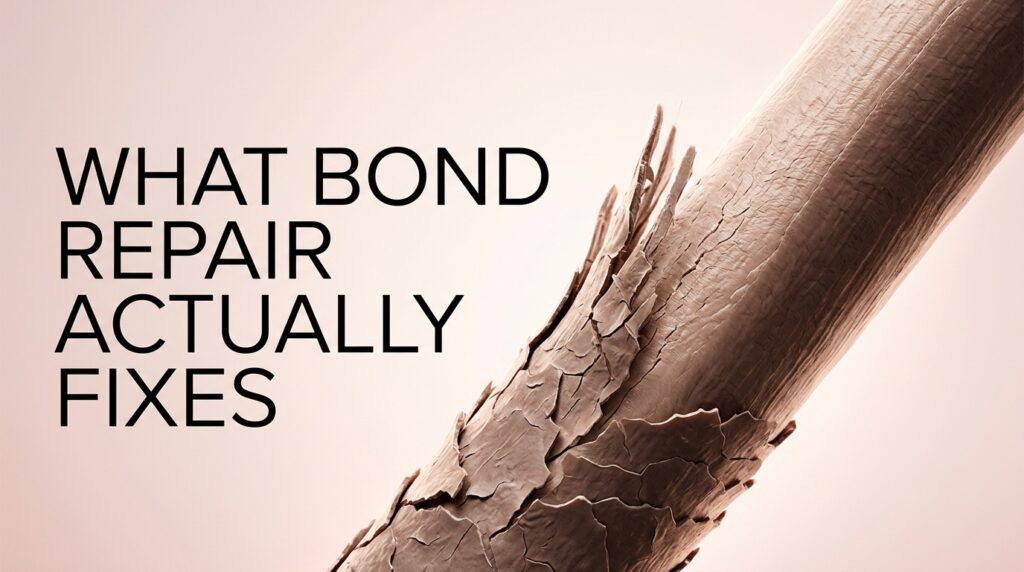
When you bleach or colour your hair, the chemical process breaks some of these disulfide bonds. Repeatedly. Over time, this causes the hair to become porous, brittle, stretchy when wet, and prone to snapping. Add Indian hard water, high humidity, heat styling and pollution into the mix, and the damage compounds faster than you’d expect.
There’s also a second category worth knowing: hydrogen bonds. These are weaker, more temporary links that are broken every time you wash your hair or expose it to humidity. They reform when the hair dries. Bond builders generally do not target hydrogen bonds. That’s important to keep in mind.
What Does L’Oréal Professionnel Absolut Repair Molecular Actually Do?
The Absolut Repair Molecular range is L’Oréal Professionnel‘s dedicated bond-repair system. The core technology in this line centres on targeting broken disulfide bonds within the hair’s cortex, the inner structural layer, and working to reconnect them. The result, when used correctly, is measurably stronger hair that resists breakage better and feels less brittle.
The range includes a pre-shampoo treatment mask and a leave-in serum, designed to be used together as a system. The pre-shampoo step works on the internal bond structure, while the leave-in helps seal and protect the surface. Both steps matter. Skipping one, especially the pre-shampoo treatment, will reduce how much you actually get from the system.
What it genuinely helps with:
- Hair that snaps or sheds excessively due to chemical services
- Post-bleach or post-colour brittleness
- Hair that stretches like chewing gum when wet (a classic sign of severe internal damage)
- Rebuilding strength before another chemical service
It does not magically restore hair that has been physically destroyed. If your ends are split, crispy and dead, bond repair will help what remains, but those ends still need trimming.
How to Use Absolut Repair Molecular at Home
- Start on dry or towel-dried hair. Apply the pre-shampoo molecular mask from mid-lengths to ends. This is not a regular hair mask. It goes on before you shampoo, not after.
- Leave it on for at least 3 to 5 minutes. You can go up to 10 minutes for very damaged hair. Do not rinse with hot water. Lukewarm is best, especially in hard-water cities like Delhi or Bengaluru where hot water opens the cuticle further and strips product.
- Shampoo normally, then condition as usual. On very damaged hair, a good conditioner after your shampoo step still helps the cuticle layer.
- Apply the leave-in serum on damp hair before blow-drying or air-drying. A few drops are enough. This step helps protect the bond work you’ve just done from heat and humidity.
- Frequency: Once a week for damaged hair. Once every two weeks for maintenance.
One honest note: if your water is extremely hard (common in many parts of North India), consider doing a quick chelating or clarifying shampoo wash every few weeks to remove mineral buildup before your bond treatment. Mineral deposits sit on the hair shaft and physically block any treatment from penetrating properly.
Where Does Olaplex Fit In?
You cannot have this conversation without mentioning Olaplex, because it essentially created the bond-repair category. Olaplex works by linking broken disulfide bonds through a single-ingredient technology. The at-home range, particularly Olaplex No.3 (the Hair Perfector) and Olaplex No.5 (the bond maintenance conditioner), are widely used in India and genuinely effective for maintaining bond integrity between salon visits.
Olaplex No.3 is used similarly to a pre-shampoo treatment. It’s not a conditioner and it won’t make your hair feel immediately silky the way a mask does. That surprises people. What it does is work internally, which means the payoff is stronger hair over time, not a quick cosmetic softness hit.
Both Absolut Repair Molecular and Olaplex are targeting the same structural problem through similar chemistry. Neither is a clear winner for everyone. Olaplex has a longer track record and broader clinical documentation. The L’Oréal Professionnel range integrates well if you’re already using other products from that salon ecosystem and your stylist is familiar with the system.
The Real Limits of Bond Builders, Every One of Them
Here’s what nobody tells you clearly enough: bond builders repair broken bonds, but only the bonds that still exist. If the hair fibre is so degraded that there’s nothing left to bond, no product can fix it.
Specifically, bond builders cannot:
- Restore hair that has reached the point of mechanical disintegration (you’ll know this stage because the hair literally dissolves or breaks apart with almost no force)
- Reverse split ends. You can temporarily smooth them with silicones or proteins, but the split is a physical separation and only a trim fixes it
- Undo the permanent structural changes from very aggressive bleaching or repeated overlapping chemical services without a trim
- Replace keratin lost through extreme porosity. Bond repair and protein treatment are different things. Very porous hair often needs both
- Protect hair from future damage if you keep repeating the same damaging services without adjusting your routine
Think of it this way. Bond repair is like welding cracked metal. It works beautifully on cracks. But if the metal has already crumbled into pieces, welding those pieces together is not the same as having solid metal again.
Who Should Use Bond Repair Products?
Bond repair treatments are genuinely worth it if you have:
- Colour-treated, highlighted or bleached hair
- Hair that’s had keratin smoothening or any other chemical service
- Hair that feels weaker after a few months of heat styling
- Fine Indian hair that breaks easily even without chemical services (fine hair has fewer disulfide bonds to begin with and loses them faster)
Skip it if: your hair is genuinely healthy and virgin. Bond repair is corrective technology, not a general conditioner. Using it on perfectly healthy hair won’t cause harm, but you’re spending money on a problem you don’t have. A good moisturising mask will serve you better.
A Note on Indian Hair and Humidity
Indian hair, particularly South Indian hair, tends to be denser and coarser than European hair, which actually gives it some structural advantages. However, the combination of frequent oiling traditions, hard water mineral buildup, and high humidity means that porosity and surface damage are very common even without heavy chemical services. Bond repair can help, but pairing it with a good chelating wash (to remove mineral deposits) and a lightweight protein treatment makes a bigger difference for most Indian hair types than bond repair alone.
For Salon Professionals
Consultation and Strand Assessment
Before recommending or applying any bond repair service, do a wet stretch test. Take a single wet strand and gently stretch it. Healthy hair stretches about 30% and springs back. Hair with significant bond damage will stretch far beyond that, or simply snap with almost no resistance. This tells you how much internal damage you’re actually dealing with and helps you set realistic expectations with your client before they spend money.
For clients coming in for bleach, highlights or any colour lift, always discuss a bond builder additive at the consultation stage, not as an afterthought. In humid cities like Chennai or Kochi, where hair is already managing moisture-related porosity, the case for using a bond repair additive during colour is especially strong.
Integrating Absolut Repair Molecular Into Your Service Menu
The Absolut Repair Molecular system works well as a standalone bond repair treatment, chargeable as an add-on to any colour or bleach service. It also works as a monthly maintenance treatment for clients who colour regularly but want to avoid the cumulative damage that usually catches up after 12 to 18 months of colouring.
Position it clearly: this is an internal structural treatment, not a smoothening or shine treatment. Clients who expect it to feel like a keratin or a glossing service will be confused. Brief them that the visible payoff is less breakage, more elasticity and fewer snapping strands over time, not immediate softness or slip.
Retail Recommendations
The at-home system (pre-shampoo mask plus leave-in serum) retails at a broad INR range that varies by city and stockist. Prices shift across salons and authorised retailers, so check current stockist pricing before advising clients. What matters is that you explain the correct order of use, because most clients will apply the mask after shampooing like a regular hair mask and then wonder why they’re not getting results.
If your salon also retails Olaplex No.3 as a take-home, both can coexist in a client’s routine. There’s no conflict in using them on alternate weeks. Some clients with very damaged hair actually benefit from rotating between the two rather than committing to only one system. Be honest about this rather than pushing one product exclusively. Clients remember that kind of honest advice, and it builds long-term trust.
Aftercare Advice to Give Clients
- Use a sulphate-free or mild sulphate shampoo between bond repair treatments to avoid stripping the work done
- Recommend a wide-tooth comb on wet hair, always from ends upward, to avoid mechanical breakage that undoes the structural repair
- For clients in hard-water areas, a monthly chelating shampoo session at the salon or at home is essential. Mineral buildup blocks product penetration and reduces the value of every treatment they do
- Remind clients that heat protection is non-negotiable. Repaired bonds are still vulnerable to heat degradation if the hair isn’t protected before blow-drying or straightening
FAQs
Can I use L’Oréal Absolut Repair Molecular and Olaplex No.3 together in the same routine?
Not in the same wash session, but you can alternate them on different weeks. Both target disulfide bond repair, so using one per wash session is enough. Some people with very damaged hair rotate between the two and find it effective. There’s no chemical conflict between them.
How long does it take to see results from bond repair treatments in damaged Indian hair?
Most people notice reduced breakage and better elasticity after two to four consistent weekly uses. Don’t judge the product after one application. Bond repair is cumulative. If you’re also dealing with hard water damage or mineral buildup, do a chelating wash first to clear the way for the treatment to actually absorb.
Is bond repair the same as a protein treatment? Do I need both?
They’re related but not the same. Bond repair reconnects broken disulfide bonds within the keratin structure. Protein treatments deposit hydrolysed proteins on or into the hair shaft to fill gaps and reinforce the fibre. Very damaged or high-porosity hair, which is common in Indian hair exposed to hard water and heat, often benefits from both. Using them together on the same day can cause protein overload, so space them out by at least a week.