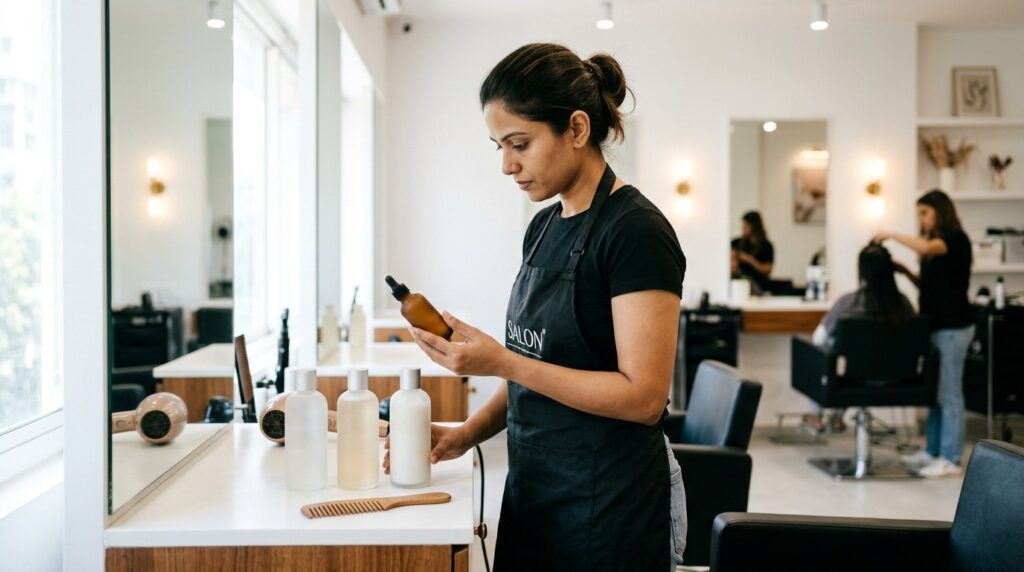
Walk into a large supermarket or a modern pharmacy chain in any Indian metro today and you will likely spot a shampoo or treatment from a brand you recognise from the backbar of your favourite salon. L’Oréal Professionnel, Wella Professionals, Matrix, Schwarzkopf Professional, and even Kérastase have been showing up on retail shelves in ways that would have felt unthinkable a few years ago. Salon owners who believed they had some degree of exclusivity over these products are understandably frustrated. The story behind how this is happening is messier than most brand representatives will admit in public.
The Official Explanation Most Brands Are Giving
When salon owners raise the alarm, the standard response from brand representatives tends to go something like this: we are not selling directly to supermarkets or general retail chains, and our professional distribution policy has not changed. What is actually happening, they say, is that some salon owners or authorised distributors are purchasing stock in bulk and then quietly reselling it to these retail chains at a margin.
This practice, often called grey-market or parallel distribution, is not new globally. But in India, where the professional haircare segment has grown significantly over the last decade and the distribution network has expanded deep into tier-two and tier-three cities, the scale of this quiet reselling has grown too. More salons buying product means more product moving through informal channels.
It is worth pausing here to say this plainly: if this explanation is accurate, the brands themselves are not directly responsible for breaking exclusivity. But it also means that enforcing channel integrity is largely being left to the brand’s sales and compliance teams, and many salon owners feel that enforcement has been slow or inconsistent.
Why This Matters More in India Than Almost Anywhere Else
Indian salons operate in a uniquely competitive environment. The salon around the corner is not just competing with the next salon. It is now competing with quick-commerce apps, large beauty retailers, and supermarkets, all of which can stock and deliver a bottle of professional shampoo faster than a client can book an appointment.
The Indian climate makes this more loaded than it sounds. Clients dealing with monsoon frizz, hard water damage from borewells in cities like Bangalore and Delhi, or scalp issues worsened by heat and pollution are precisely the clients who benefit most from genuinely professional guidance. When a product formulated for salon use gets picked off a supermarket shelf without any consultation, the client may use it incorrectly, blame the product or the salon when it does not work, and the salon loses both the retail revenue and the trust.
Kérastase, for instance, has a reputation in Indian salons for being positioned as a premium recommendation tied to a diagnosis ritual. When those products appear in a supermarket without context, the perceived value shifts. The same logic applies to Wella Professionals or Schwarzkopf Professional colour-care ranges that are genuinely designed to complement in-salon treatments.
What the Brands Say They Are Doing About It
Most of the major players have acknowledged the problem in some form. The usual responses include tightening distributor agreements, introducing batch-code tracking, and increasing field-team visits to verify how authorised salons are managing their stock. Some brands have introduced packaging or labelling differences between their professional supply and any consumer-facing variants they choose to launch separately.
The honest reality is that tracking stock once it leaves a distributor and lands with hundreds of small salon owners across a country as large and logistically complex as India is genuinely difficult. A salon in a smaller city that decides to sell a few bottles to a local grocery chain is not easy to catch quickly.
If you are a salon owner reading this and you have noticed a brand’s product on a nearby supermarket shelf, the most direct step is to raise it formally with your brand representative in writing. Keep records. This creates documented pressure on the brand to act and also protects your relationship with them if you are ever questioned about your own purchasing volumes.
For Salon Professionals
Protecting Your Position and Your Revenue
The arrival of professional products in general retail is genuinely disruptive, but there are practical ways to protect your salon’s value proposition. Here is what experienced salon owners are doing right now.
- Shift the conversation to service, not product. A client can buy a bottle of Matrix or L’Oréal Professionnel shampoo at a supermarket. They cannot buy a professional scalp analysis, a customised treatment protocol, or the hands-on expertise that comes with a trained stylist. Make sure your consultation process makes this obvious from the first visit.
- Document your diagnostic process. When you recommend a Kérastase Nutritive range or a Wella Professionals bond-strengthening treatment, note down why, what the client’s hair condition was, and what results to expect over time. This creates a record clients can see and a reason to return to you for follow-up rather than just repurchasing off a shelf.
- Build a retail experience that supermarkets cannot replicate. Bundle retail product recommendations with a complimentary 10-minute home-care consultation. Show the client exactly how to apply a treatment mask for Indian hair types, how much product to use given water quality in their area, and what to avoid during the monsoon months. This takes under 15 minutes and makes you irreplaceable.
- Talk to your brand representative about authorised retail pricing. Some brands have minimum retail price guidelines for salon retail. Selling below these, or near what a supermarket charges, undercuts your own positioning. Sell at the correct salon retail price and justify it with your expertise.
- Raise grey-market sightings formally. If you spot a professional product at a nearby chain, photograph the shelf placement and batch code if visible, and send it to your brand contact. Brands track these reports. Consistent reporting from salon partners is one of the few levers that actually accelerates brand-side enforcement.
- Consider diversifying your retail offering. Explore whether your brand partners have salon-exclusive ranges, sizes or formats that are genuinely not available in general retail. Several brands maintain SKUs that are only distributed through the professional channel. These are worth prioritising in your retail cabinet.
Consultation and Aftercare: Staying Relevant
One of the strongest arguments for buying from a salon rather than a supermarket is the quality of aftercare guidance. After any chemical service, whether keratin smoothening, a colour appointment, or a scalp treatment, your written aftercare instructions should reference specific products by range and explain exactly why they suit the client’s hair condition. Always conduct a patch test before chemical colour or treatment services, as per standard professional practice, and make sure clients know to contact you or a dermatologist if they experience any irritation or reaction. This kind of accountable, personalised guidance is something a supermarket shelf simply cannot offer.
Service Menu Positioning
This is also a good moment to review how your service menu talks about the products you use. Instead of simply listing “Kérastase treatment” or “Wella colour,” describe the outcome and the professional process. Clients who understand what makes a service genuinely professional are far less likely to feel that picking up a bottle at a supermarket is an equivalent experience.
The Bigger Picture for Indian Salons
What is happening in the market right now is uncomfortable, but it is also clarifying. The salons that have built their value around expertise, consultation and outcomes rather than product access alone are weathering this shift much better than those that leaned primarily on the prestige of carrying certain brands. That prestige, as it turns out, was always more fragile than it seemed.
The professional haircare brands themselves have a genuine interest in resolving this, because grey-market distribution dilutes brand perception and reduces salon partners’ motivation to promote those brands. But resolution takes time, and in the meanwhile, the smartest move for any Indian salon owner is to double down on what supermarkets structurally cannot provide: knowledge, personalisation, and professional accountability.
FAQs
Is the Kérastase or L’Oréal Professionnel product I see in a supermarket the same as what salons use?
It may be the same product that was originally sold through professional distribution channels and then resold to the retailer through informal means. Some brands also produce separate consumer-facing versions. Without knowing the specific batch origin, it is difficult to say with certainty. Buying from an authorised salon ensures you are getting the product with professional guidance on how to use it correctly for your hair type and local conditions.
Why are professional haircare brands allowing their products to be sold in supermarkets?
Most brands say they are not directly authorising this. The common explanation is that some authorised salon buyers or distributors are reselling stock to retail chains without the brand’s approval. This is a channel integrity problem the brands are working to address, though enforcement across a country like India is slow and inconsistent.
As a salon owner, what can I do if I see a professional brand I stock appearing in a supermarket near me?
Photograph the shelf placement and note any batch codes visible on the packaging. Report this formally to your brand representative in writing, and ask for a written acknowledgement. Keep a record of all such communications. This puts documented pressure on the brand to investigate and act, and it establishes your salon as a serious, compliant partner in their distribution network.