A client who walks into your salon is trusting you with their skin, their scalp and their health. That trust is the foundation of every great salon business, and it is built or broken by one thing more than any other: hygiene. These standards are not optional extras or something you revisit only when an inspection is due. They are the baseline, every single day, for every single client.
Why Hygiene Standards Matter More Than Ever in Indian Salons
Indian salons operate in conditions that genuinely challenge hygiene maintenance. High humidity through most of the year, seasonal monsoons that keep moisture levels elevated, dust and pollution from busy streets, and back-to-back client schedules all create an environment where bacteria, fungi and cross-contamination risks are higher than in, say, a climate-controlled European salon. Fungal scalp infections, folliculitis and skin reactions after waxing or threading are more common than they should be, and the root cause is almost always a lapse in basic hygiene protocol.
This guide covers the non-negotiables. Some of it will feel obvious. Good. It should. The goal is to make these habits so automatic that cutting a corner never even occurs to you or your team.
Linen and Towels: The Most Overlooked Risk in the Salon
Let us be direct. Reusing a towel on a second client without washing it is a hygiene failure, full stop. Towels and linen come into contact with scalp, skin, sebum, product residue and sometimes open wounds from shaving or waxing. They are one of the most efficient ways to transfer bacteria, fungal spores and head lice between clients if not handled correctly.
The standard: Every towel, cape, headband and pillow cover must be freshly laundered before use on each client. Washing must include a good-quality detergent and hot water, ideally at 60 degrees Celsius or above, which is the temperature range that reliably kills most common pathogens. Air-drying in direct sunlight is an excellent secondary step given India’s climate and the natural sanitising effect of UV exposure.
- Keep soiled linen in a closed bin, separate from clean stock.
- Never leave used towels on styling chairs or counters between clients.
- If you are running high footfall and cannot wash between every single appointment, use single-use disposable neck strips and paper towels as a bridge. They are inexpensive and remove the risk entirely.
- Salon capes should be wiped down with a disinfectant spray between clients even if they appear clean.
For facial or body treatment rooms, change the bed sheet or use a fresh disposable sheet cover for every client. Non-negotiable.
Tools and Implements: Sterilisation vs. Sanitisation
There is an important distinction your team needs to understand. Sanitising reduces the number of microorganisms on a surface. Sterilising eliminates them. For most styling tools, thorough sanitising is sufficient. For tools that touch skin or draw blood, you need sterilisation or single-use disposables.
Scissors, Combs and Brushes
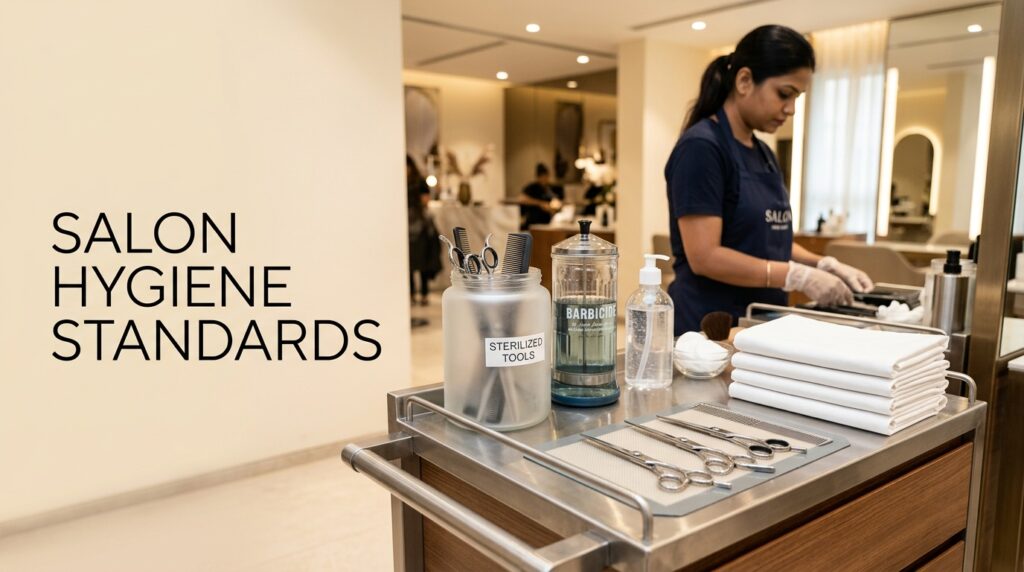
After each client, remove all hair from combs and brushes mechanically, then immerse them in a barbicide-type disinfectant solution for the manufacturer-recommended contact time. Do not just dip and remove. The contact time matters. Scissors should be wiped with a 70% isopropyl alcohol wipe between clients and sent for deeper cleaning at the end of each day.
Razors and Blades
This is where there is absolutely no room for compromise. Single-use, sterile razors must be used for every client and disposed of safely in a sharps container or a puncture-resistant sealed bin afterward. Reusing razors, even with a client’s apparent consent, is a serious infection risk and in professional practice it is simply not acceptable. Bloodborne pathogens including hepatitis B and hepatitis C can survive on a blade for longer than most people realise. Use a fresh blade. Every time. No exceptions.
Waxing Equipment
Double-dipping, where an applicator stick goes back into the wax pot after touching a client’s skin, is one of the most common hygiene violations in Indian salons. It contaminates the entire wax pot. Use a fresh stick for each application, without exception. Pre-waxing skin should be cleaned with a dedicated pre-wax cleanser, and post-waxing the skin should be soothed and protected. If a client has active breakouts, broken skin, sunburn or an undiagnosed rash in the area to be waxed, reschedule them and refer them to a dermatologist if the condition does not resolve.
Electrical Tools
Clippers, trimmers and flat irons accumulate product buildup and skin cells. Clipper blades should be brushed clean of hair, then sprayed with a blade disinfectant spray between clients. Flat irons and curling tongs should be wiped down with a damp cloth when cool and never used on a scalp with visible sores or active infection.
Skin Services: Chemical Treatments and Added Responsibility
Facials, peels, threading, waxing and any chemical service carry a higher hygiene burden because the skin barrier is often being worked on directly. A few standards specific to these services:
- Patch testing: For any new chemical service including chemical peels, tinting, bleaching or strong exfoliants, conduct a patch test at least 24 to 48 hours before the full treatment. Note this in the client’s record. Do not skip this for returning clients who are trying a new formulation.
- Threading: Thread is single-use. The piece of thread used for one client’s eyebrows should not go back on the spool or be used on another client. Some practitioners hold thread in their mouth, which is an additional contamination risk and should be avoided.
- Shared products: Creams, serums and masks should be dispensed with a clean spatula into a separate bowl, never applied directly from the jar to the client’s face. This protects the product from contamination and protects the client.
- Refer when in doubt: If a client presents with an active skin infection, severe acne, an open wound or an undiagnosed rash, the professional and ethical call is to decline the service and refer them to a dermatologist. This protects the client and every other client who sits in that chair afterward.
Your Workspace and Personal Hygiene
Your station is a reflection of your standards. A cluttered, product-stained counter with brushes sitting in old water sends a message before you have said a word.
- Wipe down all surfaces, including the chair, armrests, countertop and mirror, with a disinfectant spray between clients.
- Wash your hands with soap and water before and after each client. This is the single most effective infection-control measure available to you. Hand sanitiser is a supplement, not a replacement.
- Keep nails short and clean. Long nails harbour bacteria and create a barrier to effective handwashing.
- If you have a cut or wound on your hands, cover it with a waterproof dressing and wear gloves for any service involving skin contact or chemicals.
- Wear clean workwear every day. Your apron or uniform is also a contamination vector.
Ventilation, Water Quality and the Indian Salon Context
Hard water is a reality in most Indian cities, and it affects not just your clients’ hair but also your salon’s cleanliness. Scale buildup in shampoo bowls and around taps is not just cosmetic. It can harbour bacteria. Clean shampoo bowls with a limescale remover regularly, and ensure the bowl itself is disinfected between clients with a spray solution.
Ventilation matters enormously during chemical services. Keratin treatments, bleaching, perming and nail services release fumes that can be harmful with prolonged exposure. Ensure your salon has adequate cross-ventilation or an exhaust system. During the monsoon, when windows may be closed, a small fan directing fumes outward makes a real difference. This protects you and your team as much as your clients.
Maintaining Client Records for Hygiene and Safety
A simple client consultation card or digital record that notes known allergies, previous reactions, patch test results and skin or scalp conditions is one of the most practical hygiene and safety tools you have. It removes guesswork, protects you professionally and allows you to flag if a client should avoid a specific service. Build this habit from day one with every new client.
Building a Hygiene Culture in Your Team
Standards are only as strong as the weakest link in your team. One junior who skips sanitising their comb because it is busy on a Saturday afternoon is enough to cause a problem. Build hygiene into your onboarding process, your daily opening checklist, and your in-salon culture. Brief your team at the start of each day. Reward consistency, not just speed or upselling.
Consider a simple daily and weekly checklist posted in the back room. Daily tasks cover tool sanitising, linen checks and surface wipes. Weekly tasks cover deeper cleaning of the shampoo area, disinfectant solution changes and equipment maintenance. Make it visible and make it someone’s responsibility each day.
FAQs
How often should salon towels be washed in India?
Every towel must be washed with detergent and hot water after each use on a single client. In a high-footfall Indian salon, this means daily laundry runs at minimum. If this is not manageable, single-use disposable towels or neck strips are a practical, hygienic alternative for certain services.
Is it safe to reuse wax applicator sticks on the same client during one session?
No. Once an applicator stick has touched the client’s skin, it should not be placed back into the wax pot. This is called double-dipping and it contaminates the entire pot, putting every subsequent client at risk. Use a fresh stick for each application, even within the same client’s session.
What should a salon do if a client shows signs of a scalp or skin infection?
The correct step is to politely decline the service and recommend the client consult a dermatologist before their next appointment. Proceeding with a service on infected skin or scalp puts the client at risk of worsening the condition and puts other clients at risk through contaminated tools and linen. Document the observation in the client record and note which tools need a more thorough sterilisation cycle before reuse.