
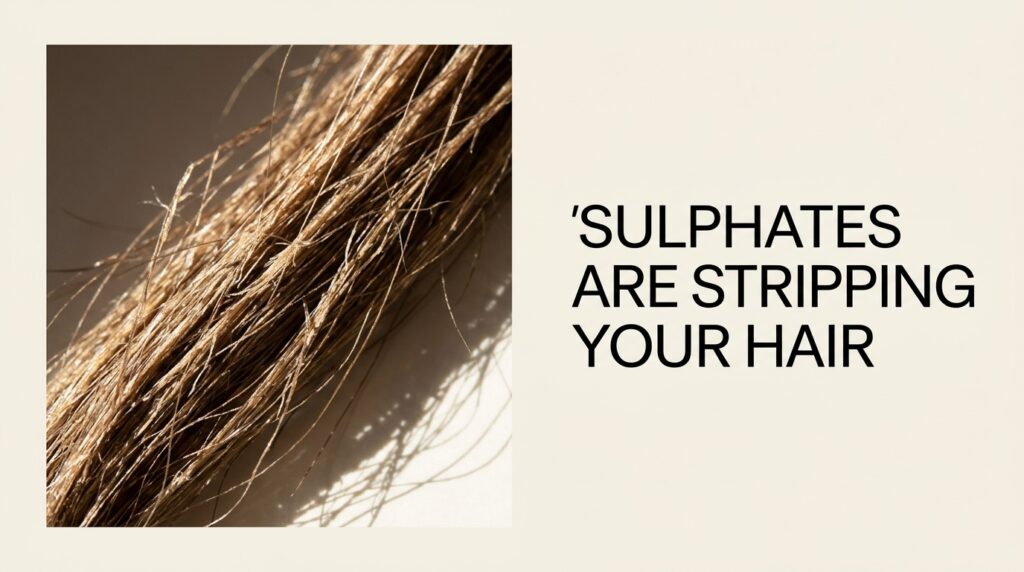
You splurged on a salon-grade shampoo, used it faithfully, and somehow your hair feels worse than before. Drier, rougher, more prone to breakage. If this sounds familiar and Matrix Biolage was involved, you are definitely not alone. The reason is actually pretty straightforward once you understand what is in the bottle and what your hair actually needs.
First, Let’s Be Honest About Matrix Biolage
Matrix Biolage is a well-known professional haircare range with a large following in India, and for good reason. The packaging is appealing, it is available at most salons, and for certain hair types it works very well. But here is the thing nobody tells you at the counter: not every product in the range suits every hair type.
The core Biolage shampoos, including popular variants like the ColorLast and Volumebloom lines, contain sulphates. Specifically, sodium lauryl sulphate or sodium laureth sulphate, depending on the formula. These are perfectly effective cleansing agents for oily scalps, fine hair, or hair that gets sweaty and grimy quickly in Indian humidity. But if your hair is already dry, chemically treated, or naturally coarse and porous, sulphates can strip away the natural oils your strands desperately need.
That is not a flaw unique to Biolage. It is just chemistry. The product was not designed with dry hair as its primary concern.
Why Indian Dry Hair Types Are Especially Vulnerable
Think about what most of us are dealing with in India. Hard water in cities like Delhi, Mumbai, Bengaluru and Chennai that leaves mineral deposits on the hair shaft. Humidity that paradoxically makes hair frizzy and brittle rather than moisturised. Heat styling. Frequent colour treatments. And for many of us, naturally thick, coarse or wavy hair textures that are structurally more prone to dryness.
Add a high-sulphate shampoo into that mix, and you are essentially washing away whatever moisture your hair managed to hold onto. The mask or conditioner you use afterwards is working uphill. It cannot fully compensate for what the shampoo stripped out in the first place.
How to Know If Your Shampoo Is the Problem
There is a simple way to check. After you wash your hair and let it air dry, run your fingers through it without adding any product. Does it feel:
- Rough or straw-like, not smooth
- Tangly and hard to separate without pulling
- Dull rather than glossy
- Noticeably worse in texture than before you started this shampoo
If yes, your cleanser is likely over-stripping your hair. The mask or conditioner may be giving you temporary softness, but the cycle of dryness continues every wash day.
What to Use Instead: Gentle Alternatives for Dry Hair
You do not have to leave Matrix entirely if you like the brand. The Matrix Biolage HydraSource range is formulated with moisture as the primary goal, and it tends to be gentler than some of the other lines. That said, always check the ingredient list on the specific bottle before buying.
If you want to look beyond Biolage, here are the categories and specific ranges genuinely worth considering for dry hair:
Sulphate-Free or Low-Sulphate Shampoos
A sulphate-free formula does not mean less clean. It means gentler cleansing that does not strip moisture. Kérastase Nutritive Bain Satin is a classic recommendation for dry to very dry hair and has been a reliable option for years. Schwarzkopf Professional BC Moisture Kick and the Wella Professionals Nutri-Enrich range are also widely available at Indian salons and worth asking about. For a more affordable option, the L’Oréal Professionnel Serie Expert Absolut Repair range works well for dry and damaged hair, though it leans more toward repair than pure moisture.
Co-Washing and Cream Cleansers
If your scalp is not excessively oily, co-washing (using a conditioner or cream cleanser instead of shampoo) once a week can give your hair a break from any cleanser. This is especially useful in cooler months or if you do not sweat heavily at the scalp. It is not a permanent switch, but a useful rotation.
Using Your Mask Correctly
A lot of people use the Biolage mask as a quick rinse-out treatment for two minutes and then wonder why it is not working. Deep conditioning masks need time. Apply to mid-lengths and ends after shampooing, leave on for at least ten minutes, ideally under a shower cap with some warmth. That is when you actually get the benefit.
A Word on Hard Water
If you live in a hard water city, even the gentlest sulphate-free shampoo may not fully fix your dryness problem. Mineral buildup on the hair shaft blocks moisture from penetrating. Consider using a chelating or clarifying shampoo once a month specifically to remove that buildup, then follow immediately with a deep conditioning treatment. This one-two approach can make a significant difference.
Who Should Skip High-Sulphate Shampoos Entirely
- Anyone with chemically coloured, bleached or highlighted hair
- People with naturally coarse, thick or 3a-4c curl textures
- Those with a dry, itchy or sensitive scalp
- Anyone who has had a smoothening or keratin treatment
- People with visibly brittle or snapping hair ends
If you fall into any of these groups, a high-sulphate shampoo is working against you regardless of the brand name on the bottle.
The Bottom Line
Matrix Biolage is a legitimate professional brand with some genuinely good products. The problem is not that it is bad. The problem is that a sulphate-based shampoo and a dry hair type are a mismatch, and nobody explained that to you when you bought it. Switching to a sulphate-free or low-sulphate alternative, adjusting how you use your mask, and addressing hard water if that is a factor will make a far bigger difference than buying yet another mask to layer on top of a stripping shampoo.
If your hair is severely damaged or the dryness has been going on for a long time, a visit to a professional trichologist is worth it. They can assess whether there is an underlying scalp or health issue at play, which no shampoo can fix on its own.
FAQs
Is Matrix Biolage shampoo good for dry hair?
Some variants in the Biolage range, like HydraSource, are formulated for dry hair and tend to be gentler. However, many popular Biolage shampoos contain sulphates, which can strip moisture from already dry or chemically treated hair. Always check the specific product’s ingredient list and consider a sulphate-free alternative if your hair is dry or damaged.
Can a hair mask make dry hair worse if you use the wrong shampoo?
Yes, it can. If your shampoo is over-stripping your hair, the mask is constantly playing catch-up. You may feel temporary softness after conditioning, but the dryness returns with every wash because the root cause is the cleanser. Switching to a gentler shampoo often makes the mask work far more effectively.
Which sulphate-free shampoo is best for dry hair in India?
There is no single best option, as it depends on your hair texture, scalp type and budget. Kérastase Nutritive, Wella Professionals Nutri-Enrich and Schwarzkopf BC Moisture Kick are professional-grade options available at Indian salons. Ask your stylist for a sample before committing, since what works for one hair type may not suit another. Prices vary across cities and retailers.
Pingback: Sulphate-Free vs Low-Poo vs Co-Wash for Dry Indian Hair