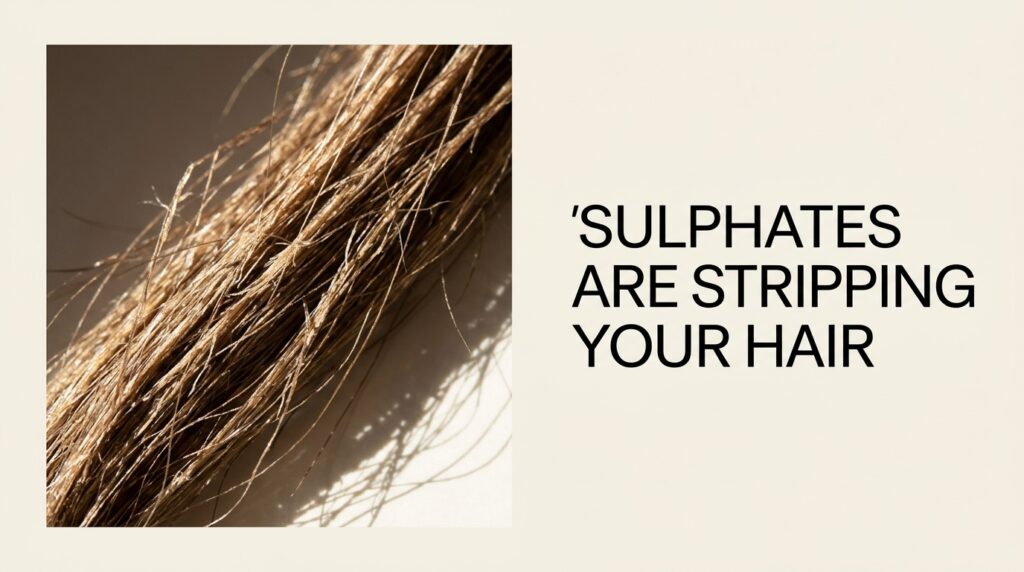
If your hair feels dry, rough and frizzy no matter what you buy, your shampoo may be cleaning too well. That is why so many people with dry Indian hair are moving away from regular sulphate shampoos. But the alternatives come with confusing names: sulphate-free, low-poo, co-wash and no-poo. Here is what each one means and who it actually suits.
Why Cleansing Strength Matters for Dry Hair
Strong surfactants like sodium lauryl sulphate (SLS) remove oil and build-up very efficiently. On an oily scalp that is useful. On dry, coloured, curly or chemically smoothened hair, it can strip the little natural oil the lengths have. We looked at this in detail in why some salon shampoos leave hair dry.
1. Sulphate-Free Shampoo
These use milder surfactants such as cocamidopropyl betaine, sodium cocoyl isethionate or glucosides. They still lather (usually less) and still clean the scalp properly.
Best for: most dry, coloured, keratin-treated or smoothened hair. This is the safest first switch for most people.
2. Low-Poo
“Low-poo” is a broader term for any very gentle, low-lather shampoo. Many are sulphate-free, but some go further with very mild cleansers and added conditioning agents.
Best for: very dry, curly or coily hair, and people who wash often but want minimal stripping.
3. Co-Wash (Conditioner Washing)
Co-washing means “washing” with a cleansing conditioner instead of shampoo. It lifts a small amount of dirt while leaving a lot of moisture behind.
Best for: thick, curly, very dry lengths between proper washes.
Watch out: co-washing alone does not clean the scalp well enough for most Indian scalps, especially with oiling habits, sweat and pollution. Use it as an in-between wash, not a replacement.
4. No-Poo
No-poo means skipping shampoo entirely and using water, baking soda, vinegar rinses or similar. It is popular online, but it is not a good fit for most people in India. Hard water, heavy oils and humid weather lead to build-up, itching and dandruff quickly. Baking soda is also very alkaline and can roughen the cuticle.
Best for: very few people. We would not recommend it for routine use.
Hard Water Changes the Picture
In many Indian cities, hard water leaves mineral deposits that make hair feel dull and straw-like even with a gentle shampoo. If you go sulphate-free, add a clarifying or chelating wash once every two to four weeks to remove that build-up. Gentle cleansers on their own may not remove it.
How to Switch Without Your Hair Feeling Greasy
- Shampoo twice: the first wash breaks up oil, the second actually cleans.
- Focus shampoo on the scalp and let the rinse clean the lengths.
- If you oil your hair, apply shampoo on dry or slightly damp hair before adding more water.
- Give it two to three weeks. Hair often feels different while it adjusts.
Quick Guide
- Dry or coloured hair, normal scalp: sulphate-free shampoo.
- Very dry, curly hair: low-poo plus occasional co-wash.
- Oily scalp, dry ends: sulphate-free on the scalp, conditioner only on lengths.
- Hard water area: any of the above plus a monthly clarifying wash.
The Bottom Line
For most people with dry Indian hair, a good sulphate-free shampoo is all the change needed. Low-poo and co-washing help very dry or curly hair, while no-poo rarely works in Indian conditions. Clean the scalp properly, be gentle on the lengths, and deal with hard water separately.